Cozystack 1.5: Gateway API, Default Backups, Flux Sharding, TLS for Managed Services, and GPU Passthrough
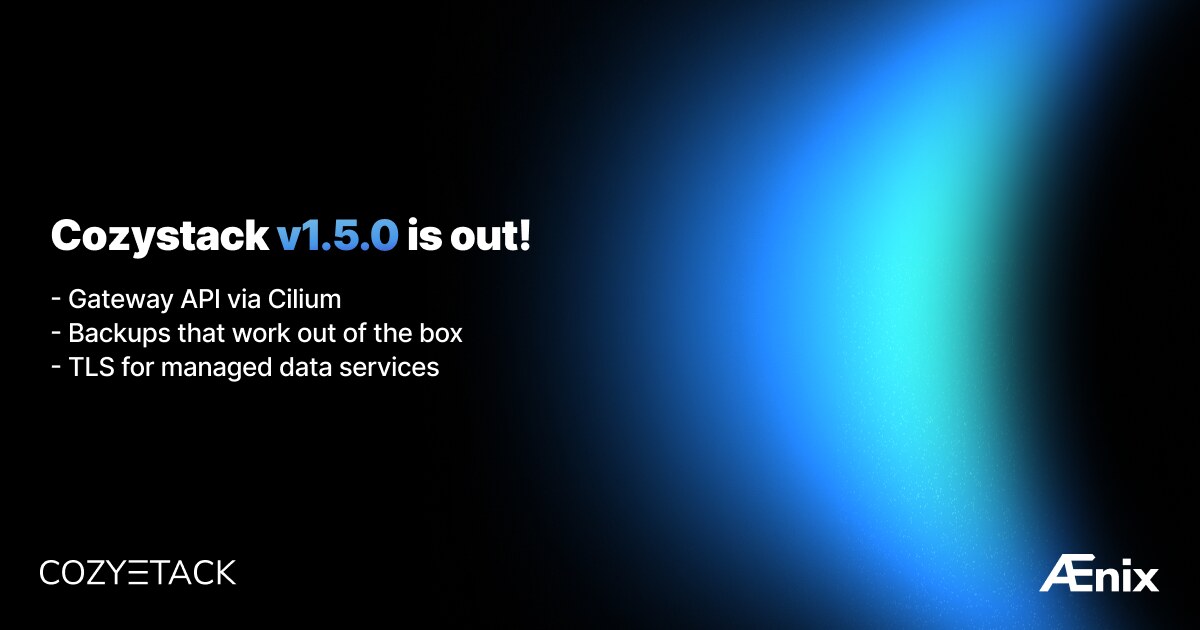
Cozystack v1.5.0 is now available. The release was published on June 22, 2026, and rolls up every fix shipped in the v1.4.1 to v1.4.4 patch line.
This release is focused on the next layer of production maturity. It makes traffic publishing more flexible, backups easier to adopt, tenant reconciliation safer, managed services more secure by default, and GPU workloads less manual to operate.
Main highlights
Gateway API support via Cilium
Cozystack 1.5 adds Gateway API support backed by Cilium.
This is an opt-in ingress path that can run alongside the existing per-tenant ingress-nginx controllers. Existing clusters keep their current behavior by default. The feature is materialized per tenant through a new gateway.cozystack.io/v1alpha1 TenantGateway CRD reconciled by cozystack-controller.
Operators can enable the new path at the platform level with publishing.gateway.enabled=true. After that, a tenant can get its own Gateway, LoadBalancer IP, and certificate through tenant.spec.gateway=true. If the value is not set, the tenant can inherit the nearest ancestor Gateway through the same label-based model already used for ingress inheritance.
Two certificate solver modes are supported.
HTTP-01 is the default mode. It gives each app its own certificate with no extra platform setup for new apps.
DNS-01 is opt-in. It uses one wildcard certificate for an apex domain and supports Cloudflare, Route 53, DigitalOcean, and RFC 2136 providers.
There are two upgrade details to know.
Cilium Envoy and Gateway API support are now always enabled, which adds a cilium-envoy DaemonSet (roughly 100 MB RAM per node at idle). Also, cozystack-api now invokes admission on Create and Delete for apps.cozystack.io/*, so custom admission policies or webhooks on these kinds will now run on all three verbs.
TLS for managed databases and messaging
Cozystack 1.5 adds TLS support for Kafka, NATS, Qdrant, and PostgreSQL external endpoints.
The model is consistent across these services. Each chart gets a tls.enabled value with tri-state behavior.
When unset, it inherits from external. This means TLS turns on automatically when the service is published externally and stays off for internal-only deployments. An explicit true or false always wins.
The trust anchor is chart-managed or operator-managed. Clients retrieve and pin the self-signed CA. There is no public CA involved.
Kafka now serves TLS on its external LoadBalancer listener on port 9094, with certificates managed by Strimzi.
NATS and Qdrant use a self-contained cert-manager chain inside the tenant namespace. NATS covers client connections and cluster routes. Qdrant covers REST and gRPC.
PostgreSQL already serves TLS through CloudNativePG. In 1.5, tls.enabled injects the external hostname into the server certificate SANs when external: true, so sslmode=verify-full works against the external endpoint.
One change needs planning. Existing instances with external: true will switch to TLS-on after upgrade. Internal instances are not affected.
Backups that work out of the box
Previous releases gave Cozystack the backup machinery. Version 1.5 makes the default path practical.
A platform-managed BackupClass named cozy-default is now shipped by default. It is backed by a shared system bucket named cozy-backups.
Apps can opt in with useSystemBucket. After that, Cozystack projects shared backup credentials into the tenant namespace with RBAC isolation and projection metrics. This removes the need to configure per-app S3 credentials for the normal path.
Default strategies are now provided for every backup-capable app: Velero for VMDisk and VMInstance, CNPG for PostgreSQL, Altinity for ClickHouse, and dedicated strategies for MariaDB, FoundationDB, and etcd.
Velero is now a default system package. This fixes a real install and upgrade problem where the default backup strategy controller depended on Velero, while Velero itself was optional. Existing clusters will get Velero in the cozy-velero namespace on upgrade. Operators who do not back up VMs can opt out with bundles.disabledPackages.
Two new backup strategies also land in this release.
The new etcd strategy is cluster-scoped and S3-only. It supports snapshot BackupJobs and destructive in-place RestoreJobs.
The new generic Job strategy gives operators an application-agnostic way to define backup and restore logic. The operator supplies a Kubernetes Job template. Cozystack renders it for backup and re-renders it with restore mode for recovery.
Flux v2.8 with stricter reconciliation
Cozystack 1.5 upgrades Flux from v2.7.3 to v2.8.0.
This affects both the embedded management-cluster Flux and the optional tenant Flux addon. The flux-operator and flux-instance charts move from v0.33.0 to v0.50.0.
Flux v2.8 brings helm-controller v1.5 with Server-Side Apply, --force-conflicts, and kstatus-based health checking by default.
This is a stricter model. Misplaced chart fields that Flux v2.7 silently ignored now become hard errors. Parent HelmReleases now wait for every child resource to become Ready before reporting Ready themselves.
This is better for correctness, but it also changes upgrade behavior.
Kubernetes 1.33 or newer is now required for the management cluster. The same requirement applies to tenant clusters that enable the Flux addon.
The old upgrade.force: true knob is removed. Immutable-field changes no longer self-heal through force replacement. If an upgrade changes an immutable field, such as StatefulSet volumeClaimTemplates or serviceName, the object must be recreated manually (for example, kubectl delete sts <name> --cascade=orphan) and reconciled again by Flux.
flux-shard-operator for tenant HelmRelease sharding
Cozystack now includes flux-shard-operator.
This operator spreads tenant HelmReleases across multiple helm-controller shards. The goal is simple: one noisy tenant should not slow down reconciliation for everyone else.
A typical bad case is a HelmRelease stuck in infinite remediation. Before sharding, that could degrade reconciliation across the tenant controller path. With 1.5, placement is assigned per tenant. All HelmReleases for one tenant share the same shard.
The default setting is shardCount: auto. Small clusters keep the current single-shard behavior. Larger fleets shard out automatically based on the tenant HelmRelease count. Operators can also pin the shard count explicitly.
The old hand-rolled flux-tenants deployment is drained and retired automatically by migration 44.
Operator-provided wildcard certificates
Operators can now serve platform services and the root tenant ingress through a pre-existing wildcard TLS certificate.
Set publishing.certificates.wildcardSecretName to the name of a TLS Secret in the publishing namespace. By default, that namespace is tenant-root.
Only the Secret name travels over the Cozystack values channel. The key material does not.
This works for both ingress paths.
With ingress-nginx, the controller serves the Secret as the default SSL certificate and platform Ingresses drop their cert-manager annotations.
With Gateway API, a new existingSecret TenantGateway certificate mode references the Secret directly and does not create an Issuer or Certificate.
The current scope is the root tenant. Extending wildcard mode to child tenants is a follow-up.
GPU passthrough without manual KubeVirt patching
GPU support gets a major operational cleanup in 1.5.
For tenant Kubernetes, node groups that declare gpus now get the gpu=on kubelet label automatically. This lets HAMi’s device plugin schedule and advertise nvidia.com/gpu.
The tenant GPU operator also loads the NVIDIA driver with NVreg_NvLinkDisable=1, which fixes a single-SXM-GPU passthrough case that could previously hang during initialization.
For KubeVirt VMs, enabling cozystack.gpu-operator now auto-populates the KubeVirt CR. It injects the HostDevices feature gate and fills permittedHostDevices from shipped NVIDIA default tables. vGPU configuration is also covered through mediatedDevicesConfiguration.
In practice, GPU VMs can now schedule without a manual kubectl patch.
There is one important upgrade note. The bundle now owns spec.configuration.permittedHostDevices. If you have custom hand-edited device entries, move them into .gpu.permittedHostDevices before upgrading and verify that each resourceName matches what your nodes advertise.
A third GPU operator variant is also added. The new container variant is for hosts where the NVIDIA driver and container toolkit are already installed by the OS. It exposes GPUs to regular containerized pods through the device plugin only.
Deletion protection for critical platform objects
Cozystack 1.5 adds a deletion-protection guardrail for critical platform objects.
Objects labeled platform.cozystack.io/no-delete=true cannot be deleted directly. The check runs in-process through Kubernetes ValidatingAdmissionPolicy. There is no webhook, DaemonSet, TLS setup, or extra image.
Protected objects include the cozy-system and tenant-root namespaces, the root tenant HelmRelease, the cozystack-version ConfigMap, the cozystack-packages package source, cert-manager ClusterIssuers, the LinstorCluster, and the packages CRDs.
If an operator really needs to delete a protected object, they can remove the label first.
This feature requires Kubernetes 1.30 or newer.
Runtime-populated dashboard dropdowns
The dashboard gets a cleaner way to show live options in create and edit forms.
A new read-only Option resource powers dropdowns that depend on cluster state. This covers GPU devices, KubeVirt instancetypes and preferences, Multus networks, VM images, storage pools, storage classes, backup classes, and backup plans.
App charts declare option sources through the new x-cozystack-options schema keyword. Tenants get read-only access to options in their own namespace.
The result is simple but important. Forms no longer need to rely on free text or stale static enums when the correct value already exists in the cluster.
Also in v1.5.0
Cozystack 1.5 also includes a broad set of platform improvements and fixes.
Tenant users can now start, stop, and restart their VMs from the dashboard. The missing KubeVirt subresource RBAC has been added at the tenant base-use level.
Platform admins get a new Tenant Overview Grafana dashboard. It shows a cross-tenant fleet summary, top consumers, usage trends, and health signals. It is deployed only to the root monitoring stack, not to per-tenant Grafanas.
A new Cluster Usage page in the dashboard is backed by dedicated RBAC. It shows cluster-wide and per-node utilization, including GPUs.
Stateful app storageClass fields are now marked as immutable in the chart schema and rendered as read-only in dashboard edit forms. This covers 16 stateful apps, including PostgreSQL, Kafka, Redis, OpenSearch, ClickHouse, MongoDB, NATS, Qdrant, RabbitMQ, Harbor, FoundationDB, MariaDB, VMDisk, and others. The reason is practical: changing storageClass does not migrate existing data.
The enforcement is UI-only in this release. Direct kubectl patch is still accepted until API-level CEL enforcement lands.
The release also fixes a long list of install, upgrade, and runtime issues. Highlights include safer OpenAPI schema publishing in cozystack-api, full upstream prometheus-operator CRDs, fixed OIDC issuer URLs in tenant kubeconfigs, containerd 2.x registry config support, KubeVirt CSI hotplug detach fixes, startup probes for slow controllers, OpenSearch availability in the PaaS bundle, and several SeaweedFS fixes after the 4.31 bump.
Platform components
Several core components are updated in this release.
Flux moves from v2.7.3 to v2.8.0.
MetalLB moves from v0.15.2 to v0.16.1. FRR-K8s is now the default BGP backend. Metrics endpoints are HTTPS-only.
SeaweedFS moves from 4.05 to 4.31. This clears the upstream 4.23 erasure-coding and multi-disk hazard and brings many S3 API correctness fixes.
etcd-operator moves from v0.4.3 to v0.4.5. The update includes restore-path fixes and backup status improvements.
ouroboros moves from v0.7.2 to v0.8.0. It now logs clearer reasons when TCP backend readiness checks fail.
seaweedfs-cosi-driver moves to v0.3.1 and can recover from stale UNIX sockets after non-graceful exits.
Cozystack also adds kuberture as a new optional system package. It watches the Kubernetes API server EndpointSlice and emits headless Services for external-dns, which helps publish Kubernetes API endpoints to DNS.
Upgrade notes
Most operators can take v1.5.0 with no manual action, but several changes need attention.
First, Kubernetes 1.33 or newer is required for the management cluster. It is also required for tenant clusters that enable the Flux addon.
Second, upgrade.force is gone. Immutable-field changes no longer self-heal through force replacement. Operators may need to recreate affected objects manually (for example, kubectl delete sts <name> --cascade=orphan) and let Flux reconcile them again.
Third, GPU VM operators must move custom host device entries before upgrading. Cozystack now owns KubeVirt.spec.configuration.permittedHostDevices when cozystack.gpu-operator is enabled.
Fourth, MetalLB now uses the FRR-K8s BGP backend by default. Metrics are HTTPS-only, so scrape configs using old HTTP endpoints must be updated.
Fifth, externally published databases and messaging services gain TLS automatically. Clients must retrieve and pin the self-signed CA. Internal services are not affected.
Documentation
This release ships with new and updated documentation for several production paths.
- Gateway API guide — the Cilium-backed publishing model, certificate modes, and migration details
- Application backup and recovery
- Managed app backup configuration
- Managed Kubernetes operations
- GPU sharing and operator variants
- Upgrade guide
- Cozystack v1.5 documentation
Thank you to all contributors
Cozystack v1.5.0 was made possible by @androndo, @Arsolitt, @elaugaste, @IvanHunters, @kvaps, @kvapsova, @lexfrei, @lllamnyp, @myasnikovdaniil, @sunib, and @tym83.
A special welcome to @elaugaste, our first-time contributor in this release. Thank you all.
Release links
Join the community
- GitHub: cozystack/cozystack
- Telegram: @cozystack
- Slack: #cozystack on the Kubernetes workspace ( invite)
- Subscribe to our community meetings calendar
- Add meetings to your calendar